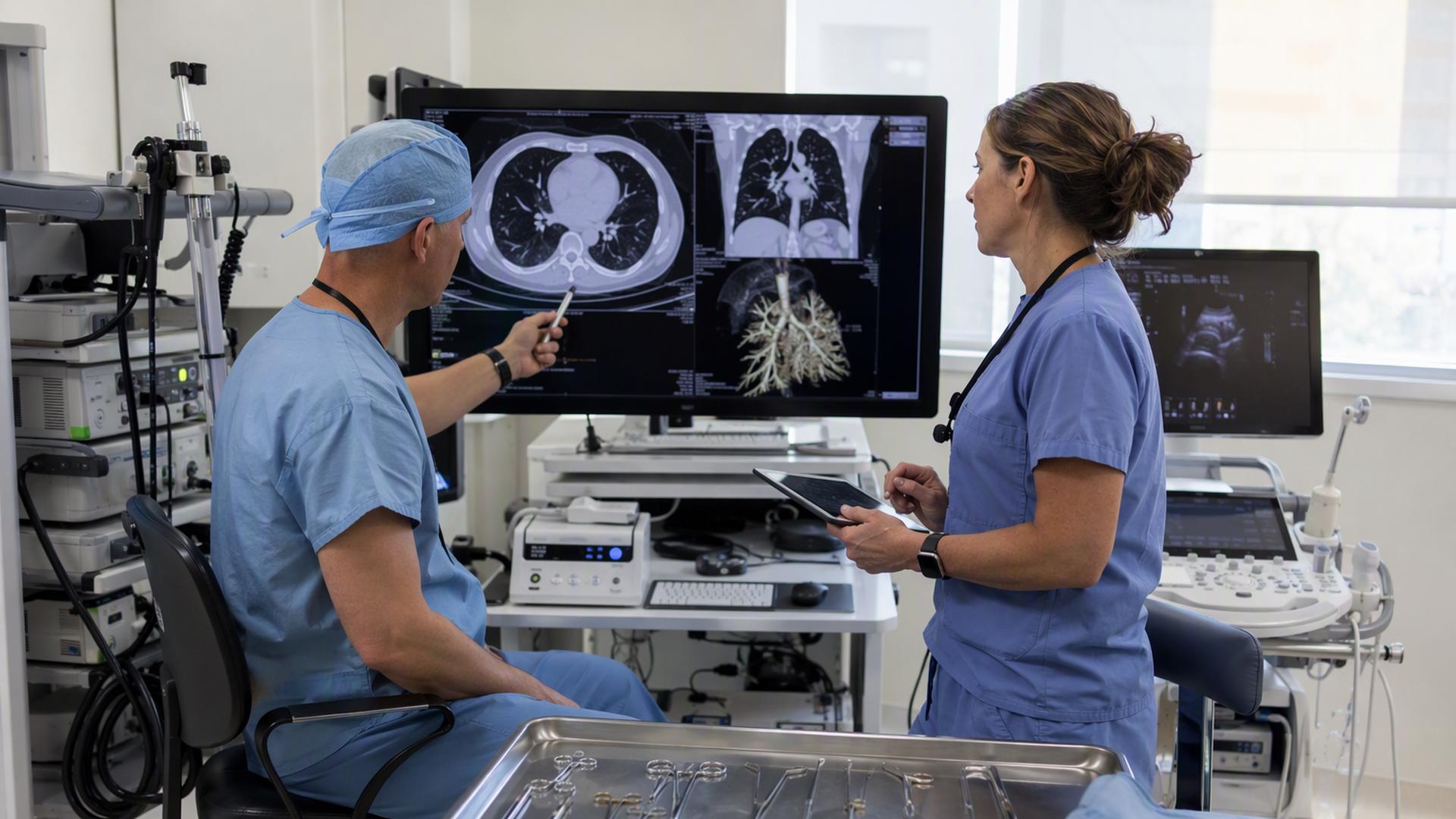
What Thoracic Surgeons Do: Lungs, Chest Wall and Beyond
Thoracic surgeons specialize in conditions affecting the chest, excluding the heart and major blood vessels in many modern practices. Their work centers on the lungs, airways, esophagus, chest wall, diaphragm, and mediastinum, the space between the lungs. They diagnose surgical problems, determine when an operation is likely to help, perform procedures, and guide patients through recovery.
Many people meet a thoracic surgeon after an abnormal chest scan, a suspicious lung nodule, persistent swallowing trouble, or a chest injury. Surgery is only one part of the specialty. Thoracic surgeons work closely with pulmonologists, medical oncologists, radiation oncologists, gastroenterologists, radiologists, pathologists, and rehabilitation teams to build a treatment plan suited to the individual condition and patient.
Treating Lung Cancer and Other Lung Conditions
A major part of thoracic surgery involves treating lung cancer. When a tumor appears confined to the lung or nearby lymph nodes, surgery may be used to remove it. The amount of lung removed depends on the tumor’s size, position, and type, as well as the patient’s breathing capacity. Before an operation, the team commonly reviews imaging, biopsy results, lung function tests, and the person’s general health.
Marco Scarci, consultant thoracic surgeon, performs minimally invasive and robotic procedures for lung cancer, including lobectomy, segmentectomy and wedge resection when surgery is appropriate.
A lobectomy removes one lobe of the lung. The right lung has three lobes, while the left has two. For many people with early-stage non-small cell lung cancer, removing the affected lobe has long been a standard operation because it removes the tumor along with nearby tissue and lymph nodes. Lymph nodes are small structures that filter fluid and can be checked for cancer cells that may have spread.
Some tumors can be treated with a smaller operation. A segmentectomy removes a defined section of a lobe, while a wedge resection removes a small, non-anatomical piece of lung tissue around a lesion. These options may be considered for selected small cancers or for people who would have difficulty tolerating removal of an entire lobe. In more extensive cases, a pneumonectomy removes one whole lung, though surgeons avoid this when a less extensive operation can safely achieve the treatment goal.
Thoracic surgeons also treat noncancerous lung problems. These can include lung abscesses, severe emphysema in carefully selected patients, repeated collapsed lungs, and persistent air leaks after injury or surgery. A spontaneous pneumothorax occurs when air escapes into the space around a lung, causing it to partially or fully collapse. Surgery may seal the leaking area and help prevent the problem from recurring.
Working on the Airways, Pleura, and Mediastinum
The airways include the trachea, often called the windpipe, and the bronchi, which carry air from the trachea into each lung. Narrowing or blockage can result from tumors, scar tissue, injury, or certain inflammatory conditions. Thoracic surgeons may remove a damaged airway segment and reconnect the healthy ends, a procedure that requires careful planning because breathing passages must remain open and properly supported.
The pleura is a thin, two-layer lining that covers the lungs and the inside of the chest wall. Fluid, air, blood, or infection can collect in the narrow space between those layers. Thoracic surgeons may drain infected fluid, remove thick scar tissue that traps the lung, or take tissue samples when imaging suggests pleural disease. Mesothelioma, a cancer linked primarily to asbestos exposure, is one condition that can arise from this lining.
The mediastinum contains the thymus gland, lymph nodes, nerves, and parts of the trachea and esophagus. Masses in this area may be benign or cancerous, and their location helps shape the surgical approach. For example, thymomas are tumors of the thymus gland that can be associated with myasthenia gravis, an autoimmune disorder that causes muscle weakness. Removing the thymus may be part of treatment for certain patients.
Repairing the Chest Wall and Supporting the Diaphragm
The chest wall is more than a protective cage of ribs. It includes bone, cartilage, muscles, skin, and connective tissue that all work together during breathing. Thoracic surgeons treat tumors that arise in or invade the ribs, sternum, or surrounding soft tissues. They may remove the involved tissue and reconstruct the area with surgical mesh, plates, or other materials designed to preserve chest stability.
Chest wall reconstruction can also be necessary after serious trauma or infection. Multiple broken ribs can create an unstable section of the chest, sometimes called flail chest, which moves differently from the rest of the rib cage during breathing. In selected cases, surgeons stabilize fractured ribs with plates and screws. This can improve mechanical stability and may help patients breathe, cough, and move more effectively during recovery.
Some people are born with chest wall differences, such as pectus excavatum, where the breastbone appears sunken, or pectus carinatum, where it protrudes forward. A thoracic surgeon evaluates whether the condition is mainly cosmetic or is affecting breathing, exercise tolerance, heart function, or emotional well-being. Treatment can range from observation and bracing to reconstructive surgery, depending on the condition and its severity.
The diaphragm is a broad muscle beneath the lungs that contracts to draw air into the chest. A weakness, tear, or abnormal opening in the diaphragm can interfere with breathing or allow abdominal organs to move into the chest. Thoracic surgeons may repair diaphragmatic injuries after trauma, correct certain hernias, or address diaphragm paralysis in selected cases. Restoring the muscle’s position and tension can improve the mechanics of breathing.
Managing Esophageal Disease and Swallowing Problems
Thoracic surgeons often care for diseases of the esophagus, the muscular tube that carries food from the throat to the stomach. Esophageal cancer is a key area of practice. Treatment may involve surgery, chemotherapy, radiation therapy, or a combination of these approaches. The sequence depends on the cancer’s location, stage, cell type, and the patient’s ability to tolerate treatment.
An esophagectomy removes part or all of the esophagus. Surgeons then create a new path for food, commonly by reshaping the stomach into a tube and bringing it up into the chest or neck. This is a substantial operation, and recovery involves attention to pain control, nutrition, lung function, and swallowing. Patients may work with dietitians and speech-language pathologists as they adjust to eating after surgery.
Not every esophageal condition requires removal of the organ. Achalasia, for example, occurs when the lower esophageal sphincter fails to relax properly, making it difficult for food and liquid to pass into the stomach. A thoracic surgeon may perform a myotomy, which cuts selected muscle fibers to reduce the blockage. Surgery can also address large hiatal hernias, diverticula, or tears in the esophagus that need urgent repair.
How Thoracic Surgery Is Performed and Planned
Open surgery uses a larger incision to give the surgeon direct access to the chest. For many conditions, however, surgeons can use minimally invasive methods. Video-assisted thoracoscopic surgery uses a small camera and specialized instruments through several small incisions. Robotic-assisted surgery also uses small incisions, with the surgeon controlling articulated instruments from a console. The appropriate method depends on the diagnosis, anatomy, previous treatment, and complexity of the operation.
Minimally invasive surgery may reduce incision-related pain and shorten recovery for some patients, but it is not automatically the best choice in every case. A large tumor, extensive scar tissue, major bleeding, or the need for complex reconstruction may require an open operation. The priority is complete and safe treatment, not the size of the incision. Surgeons may also begin with a minimally invasive plan and change approaches if safety requires it.
Preparation extends beyond the operating room. Patients may stop smoking, improve nutrition, practice breathing exercises, and complete heart and lung testing before surgery. Afterward, early walking, coughing exercises, pain management, and prevention of blood clots are common parts of care. Thoracic surgery teams monitor for complications such as pneumonia, air leaks, irregular heart rhythms, infection, and changes in breathing.
Specialized Care for Conditions Inside the Chest
Thoracic surgery combines cancer care, reconstructive work, emergency treatment, and long-term management of complex chest conditions. From removing a small lung tumor to rebuilding part of the chest wall or repairing the esophagus, the specialty is defined by precise work in an area where breathing, swallowing, circulation, and movement are closely connected. A thoracic surgeon helps patients understand the available options, the expected benefits, and the practical steps involved in recovery.

